A Versatile Vector Asset: Blue Flowering Cornflower Border
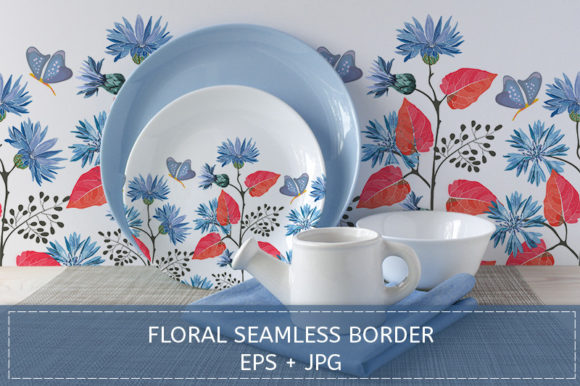
When sourcing vector graphics for professional design projects, the evaluation often hinges on two core criteria: aesthetic quality and practical utility. The asset described as Blue Flowering Cornflower—a collection featuring a floral seamless border with Centaurea flowers, buds, stems, twigs, red leaves, and butterflies isolated on white—directly addresses both. This is not merely a collection of pretty images; it is a structured design resource built for implementation.
At its heart, this package provides a classic botanical illustration rendered in a clean, vector format. The cornflower, or Centaurea cyanus, is depicted with botanical accuracy, showing the distinctive blue flowering heads alongside buds and accompanying foliage. The inclusion of contrasting red leaves and butterflies introduces a subtle dynamic element, breaking the monotony of a single-flower pattern. The key component, however, is the seamless border. This transforms the illustration from a simple isolated graphic into a repeatable design element, fundamentally expanding its application scope.
Core Characteristics and File Format Strength
The technical specifications of this package are a primary indicator of its professional grade. It includes an EPS 10 vector file, compatible with Adobe Illustrator and other vector editing software. The EPS format ensures scalability without quality loss, a non-negotiable requirement for print applications or large-scale digital outputs. Additionally, a high-resolution JPG file at 6000x3000 pixels is provided, pre-flattened and ready for quicker use in raster-based environments like Photoshop.
- Vector Integrity: The EPS file allows for unlimited editing. Colors can be adjusted, elements can be separated or rearranged, and the seamless border path can be modified. This is crucial for designers needing to match specific brand palettes or integrate the motif into a larger composite illustration.
- High-Resolution Fallback: The JPG serves multiple purposes: a quick placeholder in layouts, a usable asset for projects where vector editing is not required, and a high-quality image for web use at virtually any scale.
- Isolated Presentation: All elements are isolated on a white background. This simplifies the clipping process and provides maximum flexibility for placing the graphics onto any colored or textured surface.
Practical Value and Real-World Application
The stated purpose—decorative design of any surfaces, cards, banners—is accurate, but the real-world utility extends further. The seamless border is the standout feature. A well-executed seamless pattern can be tiled infinitely, creating backgrounds, framing elements, or decorative edges for a wide variety of media.
Consider these realistic applications: a small business owner creating branded packaging or store signage; a blogger developing a unique theme for their site header and sidebar elements; an educator designing visually appealing certificates or lesson materials; a freelance designer producing wedding invitations or event programs. In each case, the border can provide a consistent, elegant decorative thread. The botanical theme conveys a sense of natural elegance, heritage, or organic quality, making it suitable for industries like wellness, artisanal foods, gardening, or boutique hospitality.
Evaluating Usability and Flexibility
Usability in a design asset is about ease of integration into a workflow. Here, the dual-format approach caters to different user proficiencies. For the vector-savvy designer, the EPS file is the main tool, offering deep control. For those less comfortable with Illustrator, the high-res JPG is a robust alternative, especially for digital banner designs where scaling beyond 6000px is unlikely.
Flexibility is high. The isolated elements allow the user to employ just the butterflies, a single flower cluster, or the twigs as separate decorative accents. The red leaves provide a color contrast point that can be exploited to highlight text or logos placed within the border frame. However, a limitation to note is the fixed color scheme within the vector file. While colors are editable, the initial artwork uses specific shades of blue, red, and green. A designer seeking a completely different color palette (e.g., pastels or monochrome) will need to perform the recolor work themselves, which requires basic vector software skills.
Audience Fit and Project Alignment
This asset is particularly beneficial for professionals and creators who operate in environments where a consistent visual motif is valuable but custom illustration is cost-prohibitive. Marketing professionals needing rapid assets for a campaign with a "natural" or "classic" angle can integrate this border quickly. Publishers might use it for book covers or interior chapter decorations. The quality is sufficient to avoid a "stock asset" cliché, provided it is used thoughtfully and integrated well with other design elements.
It is less suitable for projects requiring ultra-modern, abstract, or minimalist aesthetics. The style is inherently illustrative and traditional. Also, for users exclusively needing photorealistic imagery or complex 3D renders, this vector illustration will not align. Its value is unlocked in print and digital graphic design where flat or semi-realistic illustration is appropriate.
Long-Term Value and Consistency
A reliable vector asset can become part of a designer’s long-term toolkit. The timeless nature of floral motifs and the technical robustness of the EPS format contribute to this asset’s longevity. It is unlikely to feel dated quickly, unlike many trend-based graphics. The consistency of the artwork—clean lines, balanced composition—means it will reproduce reliably across different media, from fine paper stocks to large format vinyl printing.
For the serious hobbyist or small business owner managing their own branding, such an asset can provide a foundational decorative element that lasts across multiple product generations or website redesigns, ensuring visual continuity without recurring licensing costs.
Ultimately, the decision to utilize the Blue Flowering Cornflower vector border depends on matching its specific characteristics to your project needs. Its strengths are clear: botanical elegance, seamless repeat functionality, and professional-grade file formats. Its requirements are equally clear: a need for a classic decorative style and some capacity, even if basic, to work with vector or high-resolution raster files. When those conditions align, it serves as an effective, versatile, and enduring design resource.